
On most maps, Iceland appears like a quiet island sitting alone in the North Atlantic Ocean.
But beneath its icy landscapes lies one of the most geologically active places on Earth.
Volcanoes shape its land. Glaciers carve its valleys. Geysers burst from the ground. Rivers flow from melting ice fields. The country feels like a living laboratory of nature’s forces.
What makes Iceland truly remarkable is not just this dramatic landscape — it’s how the country has learned to live with it, and even harness it for energy.
Few places on Earth demonstrate the power of geology quite like Iceland.
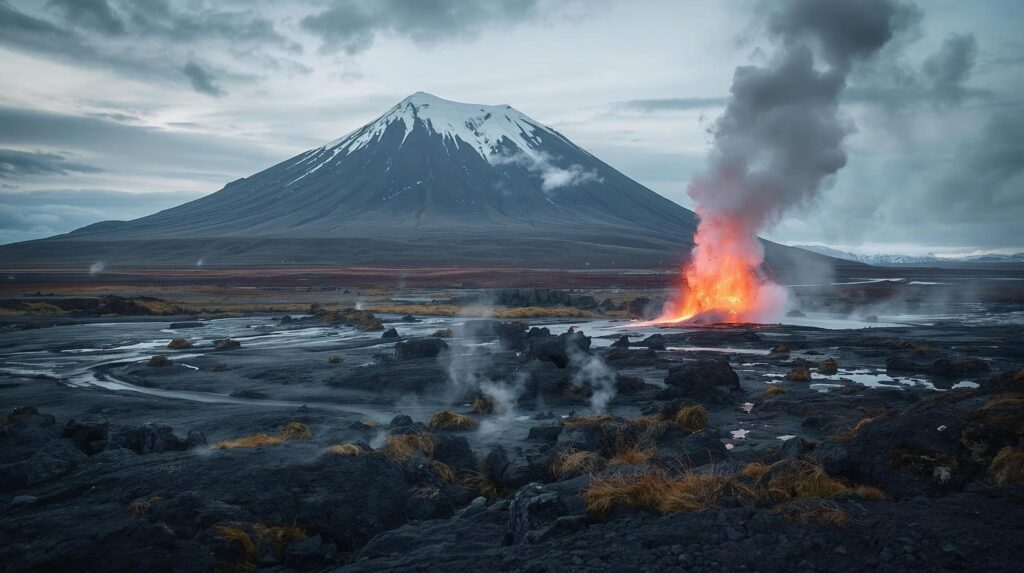
🌋 A Land Born From Fire and Ice
Iceland’s nickname — the land of fire and ice — isn’t poetic exaggeration.
The island sits directly on the Mid-Atlantic Ridge, a massive tectonic boundary where the North American and Eurasian plates slowly pull apart. As these plates drift away from each other, molten rock rises from below, creating new crust.
That process built Iceland itself.
The result is a landscape filled with volcanoes, lava fields, and geothermal vents, existing alongside enormous glaciers that cover about 10% of the country.
Nowhere else do these two forces coexist so dramatically.
🌍 One of the Most Volcanically Active Places on Earth
Iceland contains more than 130 volcanic mountains, many of which remain active.
Volcanic eruptions occur regularly, shaping the island’s geography over centuries. Some eruptions have been powerful enough to affect global climate.
One notable example occurred in 2010, when the eruption of Eyjafjallajökull sent ash clouds high into the atmosphere, disrupting air travel across Europe for several days.
While such eruptions remind the world of Iceland’s volatility, they are simply part of life for the island’s residents.
In Iceland, volcanoes are neighbors.
💧 Geysers That Gave the World a Word
The English word “geyser” actually comes from Iceland.
It originates from Geysir, a famous geothermal spring located in the country’s Haukadalur valley. Though the original Geysir erupts less frequently today, nearby Strokkur erupts every few minutes, shooting boiling water high into the air.
These geysers exist because underground water meets intensely hot volcanic rock, building pressure until it bursts through the surface.
Watching a geyser erupt is like seeing the Earth breathe.
⚡ Turning Volcanoes Into Electricity
While volcanic activity might sound dangerous, Iceland has transformed this natural heat into an advantage.
The country is a global leader in geothermal energy, using underground heat to generate electricity and warm homes.
Hot water pumped from geothermal reservoirs flows directly into heating systems across the country. As a result, Iceland’s homes, greenhouses, and swimming pools are often heated using energy drawn straight from the Earth itself.
Around 90% of Icelandic homes are heated using geothermal energy.
In many places, the ground literally provides the warmth.
🧊 Glaciers That Shape the Landscape
Despite its fiery geology, Iceland is also defined by ice.
Massive glaciers blanket large portions of the island, including Vatnajökull, the largest glacier in Europe by volume. These frozen giants carve valleys, feed rivers, and occasionally unleash powerful floods when volcanic heat melts the ice beneath them.
These sudden floods, called jökulhlaups, are dramatic reminders that Iceland’s natural forces often interact in unpredictable ways.
Fire and ice constantly reshape the land together.
🌌 Northern Lights and Endless Skies
Iceland’s northern latitude brings another natural spectacle: the Aurora Borealis, or Northern Lights.
During winter months, solar particles collide with Earth’s atmosphere, producing shimmering curtains of green, purple, and red light across the sky.
For centuries, these lights inspired myths and folklore among people living in the Arctic regions.
Today they remain one of Iceland’s most breathtaking natural displays.
🐑 A Small Nation With Big Nature
Iceland’s population is surprisingly small — just over 370,000 people.
That means the island’s dramatic landscapes vastly outnumber its residents. Vast areas remain untouched wilderness, filled with waterfalls, lava plains, and black sand beaches formed from volcanic rock.
The country also has more sheep than people, a fact that locals often mention with pride.
Life here feels closely tied to nature.
🌍 A Culture Built Around Resilience
Living in such a dynamic environment has shaped Icelandic culture.
Historically, survival depended on adaptability, cooperation, and respect for nature’s unpredictability. Harsh winters, volcanic eruptions, and isolation demanded strong communities.
Even today, Iceland ranks among the world’s most resilient societies, with strong education, high quality of life, and a deep connection to literature and storytelling.
The famous Icelandic sagas — medieval narratives of exploration and survival — still form an important part of national identity.
💡 Nature as an Ally, Not an Enemy
Many countries view geological instability as a challenge to overcome.
Iceland views it differently.
Volcanoes provide geothermal energy. Glaciers attract tourism. Rivers power hydroelectric plants. Even volcanic soil enriches certain ecosystems.
Rather than resisting its environment, Iceland has learned to work with it.
The island demonstrates something powerful: nature’s extremes can become opportunities when people understand how to harness them.
Continue Exploring on Trivialwiki
If you enjoyed discovering how geography shapes nations, don’t miss our previous post:
👉 Tardigrades: The Tiny Creatures That Survive Almost Anything
A fascinating look at microscopic animals capable of surviving extreme environments — even outer space.
📬 Stay Connected with Trivialwiki
👉 Facebook: https://facebook.com/Trivialwiki
👉 Instagram: https://instagram.com/trivialwiki
👉 YouTube: https://youtube.com/@trivialwiki
👉 Pinterest: https://pinterest.com/Trivialwiki
Learn. Explore. Discover.
Iceland shows how powerful nature can shape an entire country — what other places do you think are defined by dramatic natural forces? Share your thoughts in the comments! 🌋
1 thought on “Iceland: The Country Powered by Volcanoes”