
Most foods come with an expiration date.
Milk turns sour. Bread grows mold. Fruits soften and collapse. Even canned goods eventually lose quality over time.
But honey plays by different rules.
Archaeologists have discovered pots of honey in ancient Egyptian tombs — thousands of years old — and still perfectly edible. Not rotten. Not toxic. Not even spoiled.
It sounds like a myth. It isn’t.
Honey is one of the very few natural foods that can last indefinitely, and the reasons why are as fascinating as the fact itself.
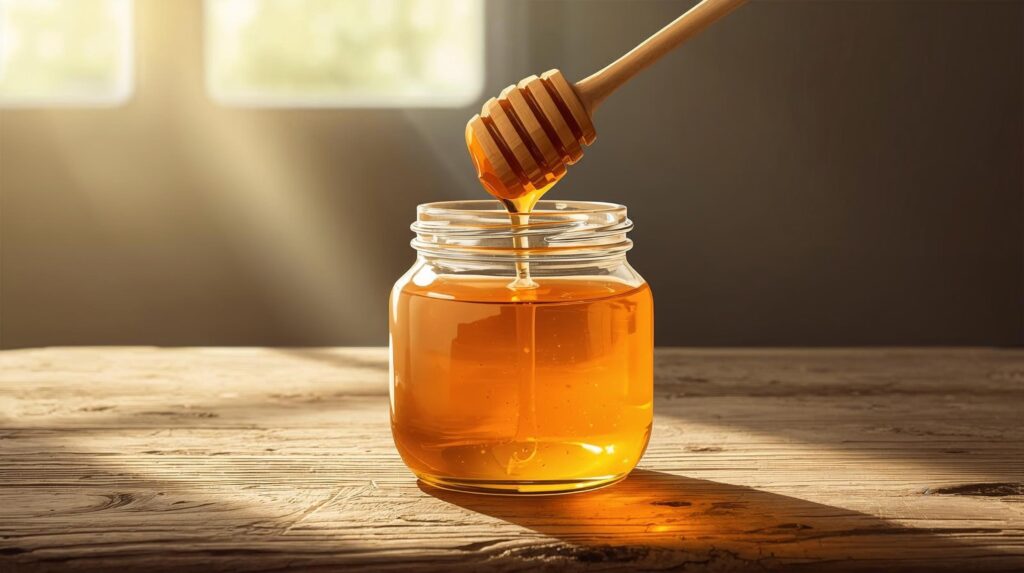
🍯 A Sugar Too Strong for Microbes
At its core, honey is mostly sugar.
But not just any sugar mixture. Honey is composed primarily of fructose and glucose in extremely high concentrations. That concentration matters because microorganisms — like bacteria and fungi — need water to grow.
Honey has almost none.
The high sugar content pulls moisture out of microbial cells through a process called osmosis. In simple terms, honey dehydrates bacteria before they have a chance to multiply.
For microbes, honey isn’t food. It’s hostile territory.
💧 The Power of Low Water Content
Fresh honey contains very little water — usually around 17% or less. Most bacteria require much more moisture to survive and reproduce.
Without water, microorganisms simply can’t thrive.
This is why honey can remain stable for decades or centuries as long as it’s sealed and kept away from excess humidity.
Add water to honey, however, and the story changes. Diluted honey can ferment. But pure, properly stored honey remains remarkably stable.
Nature engineered a near-perfect preservative.
🐝 Bees as Master Chemists
The secret of honey’s longevity doesn’t begin in a jar. It begins in a hive.
When bees collect nectar from flowers, it’s relatively watery. Back in the hive, bees repeatedly consume and regurgitate the nectar, mixing it with enzymes. They then fan it with their wings to evaporate excess moisture.
This process thickens the liquid and transforms it chemically.
One enzyme bees add is called glucose oxidase. When honey is exposed to slight moisture, this enzyme produces small amounts of hydrogen peroxide — a natural antimicrobial agent.
In other words, honey doesn’t just resist bacteria. It actively suppresses them.
Bees are not just pollinators. They are biochemical engineers.
🧪 Acidity Adds Another Layer of Defense
Honey is also naturally acidic, with a pH typically between 3 and 4.5.
That acidity creates another environment where most bacteria struggle to survive. Combine low moisture, high sugar concentration, and acidity, and you have a substance that is incredibly unfriendly to spoilage.
Few foods possess all three protective qualities at once.
Honey does.
🏺 The Ancient Egyptian Discovery
The claim that honey never spoils gained widespread attention when archaeologists found sealed jars of honey inside ancient Egyptian tombs.
These jars were thousands of years old — yet laboratory testing showed that the honey was still chemically stable and safe to eat.
The Egyptians valued honey not only as food, but also as medicine, offering, and preservative. They may not have understood the microbiology behind it, but they recognized its durability.
Time passed. Civilizations changed. Honey remained.
🌍 A Global Sweetener With a Long History
Honey predates refined sugar by millennia.
Before industrial sugar production, honey was one of the primary sweeteners available to humans. It appears in ancient Greek texts, traditional Chinese medicine, Ayurvedic practices, and countless culinary traditions worldwide.
Its durability made it especially valuable in eras when refrigeration did not exist.
Honey could be stored, transported, and traded without fear of spoilage — a practical advantage in ancient economies.
In that sense, honey was more than sweet. It was reliable.
❄️ Why Honey Crystallizes (And Why That’s Not Spoiling)
Many people assume honey has gone bad when it crystallizes or thickens.
It hasn’t.
Crystallization is a natural process where glucose separates from water and forms crystals. It’s influenced by temperature and the specific composition of the honey.
This change in texture doesn’t mean spoilage. It simply reflects honey’s chemistry.
Gently warming the jar restores it to liquid form without affecting quality.
Honey changes form. It doesn’t rot.
⚠️ One Important Exception
There is one important note: honey should not be given to infants under one year old.
Although honey resists microbial growth, it can contain dormant spores of Clostridium botulinum. These spores are harmless to older children and adults but can be dangerous to infants with underdeveloped digestive systems.
This isn’t spoilage — it’s a precaution based on infant immunity.
For everyone else, properly stored honey remains safe indefinitely.
🍯 Nature’s Preservation Strategy
What makes honey extraordinary is not just that it lasts — it’s how it lasts.
It combines:
– Extremely low moisture
– High sugar concentration
– Natural acidity
– Enzyme-based antimicrobial action
Few foods are engineered — by nature — with such layered protection.
In modern times, we rely on artificial preservatives, refrigeration, and packaging technologies to keep food fresh.
Bees perfected preservation long before humans understood bacteria.
💡 A Sweet Lesson in Natural Design
Honey’s resistance to spoilage reminds us that sometimes the most remarkable technologies are biological.
A simple golden liquid, stored in a hive, built from flower nectar, can outlast empires.
Long after civilizations rise and fall, a sealed jar of honey can remain unchanged.
Few foods can make that claim.
Continue Exploring on Trivialwiki
If you enjoyed discovering how nature builds its own preservation system, don’t miss our previous post:
👉 Japan: The Island Nation Where Tradition Meets the Future
A look at how an entire country balances ancient heritage with cutting-edge innovation.
📬 Stay Connected with Trivialwiki
👉 Facebook: https://facebook.com/Trivialwiki
👉 Instagram: https://instagram.com/trivialwiki
👉 YouTube: https://youtube.com/@trivialwiki
👉 Pinterest: https://pinterest.com/Trivialwiki
Learn. Explore. Discover.
Honey can outlast centuries without spoiling — what other everyday foods do you think hide surprising science behind their simplicity? Share your thoughts in the comments 🍯