
Stand on a map of South America and one country dominates the continent — not just in size, but in identity.
Brazil stretches across nearly half of the continent’s landmass. It borders almost every South American nation. It houses the Amazon rainforest, legendary football history, world-famous Carnival celebrations, and some of the most diverse ecosystems on Earth.
Yet perhaps its most surprising distinction is linguistic.
In a continent where Spanish overwhelmingly dominates, Brazil stands alone as the only Portuguese-speaking country — a cultural and historical divergence that shaped its entire national identity.
How did that happen? And how did Brazil grow into the giant it is today?
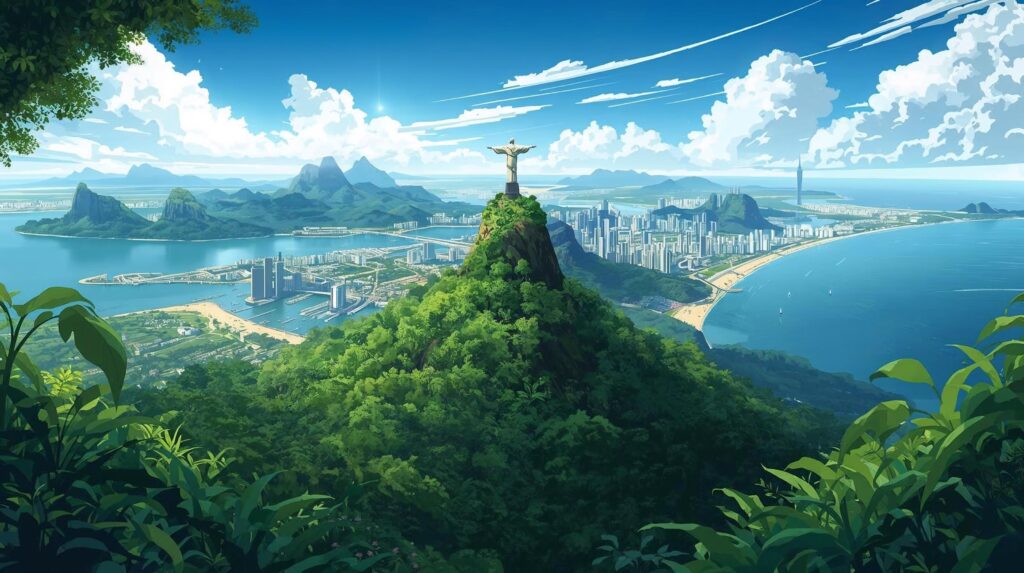
🌎 A Country the Size of a Continent
Brazil is the largest country in South America and the fifth-largest in the world. Its territory spans from the equator down toward the subtropics, covering beaches, rainforests, savannas, wetlands, and massive urban centers.
It shares borders with every South American country except Chile and Ecuador. That geographic scale has influenced everything from its economy to its cultural diversity.
Travel across Brazil and you’ll encounter dramatically different landscapes — the lush Amazon Basin in the north, the bustling cities of São Paulo and Rio de Janeiro in the southeast, the dry northeast interior, and the vast wetlands of the Pantanal.
Brazil isn’t just large. It’s layered.
📜 The Treaty That Changed a Continent
The reason Brazil speaks Portuguese traces back to the late 15th century.
In 1494, Spain and Portugal signed the Treaty of Tordesillas, dividing newly discovered lands outside Europe between them. A line was drawn across the Atlantic Ocean. Lands to the east of the line went to Portugal; lands to the west went to Spain.
At the time, neither nation fully understood the geography of South America. But when Portuguese explorers reached what is now Brazil in 1500, the territory fell on Portugal’s side of the line.
Over centuries, Portuguese settlers expanded inland, establishing colonies, plantations, and trade routes. While most of South America developed under Spanish rule, Brazil evolved separately — linguistically, administratively, and culturally.
That early geopolitical decision still shapes the continent today.
🗣️ A Language That Unifies Millions
Today, Brazil is home to over 200 million Portuguese speakers, making it the largest Portuguese-speaking country in the world — far surpassing Portugal itself.
This linguistic unity sets Brazil apart in South America. While Spanish-speaking nations share similarities in grammar and vocabulary, Portuguese sounds distinct and carries its own rhythm and cadence.
Language influences culture deeply. Brazilian literature, music, and media developed along a slightly different path from its neighbors. Even diplomatic and trade relations often carry a unique tone because of this difference.
Brazil is part of South America — but it is unmistakably its own world.
🌿 The Amazon: Brazil’s Global Responsibility
Nearly 60% of the Amazon rainforest lies within Brazil’s borders.
The Amazon is often described as the “lungs of the Earth,” though that phrase simplifies its ecological complexity. What’s undeniable is that the rainforest plays a critical role in regulating global climate, storing carbon, and sustaining biodiversity.
Brazil’s stewardship of the Amazon places it at the center of global environmental discussions. Decisions made in Brasília ripple far beyond South America.
Few countries carry such environmental weight.
🎭 A Cultural Fusion Like No Other
Brazilian culture is the result of centuries of blending — Indigenous heritage, Portuguese colonial influence, African traditions brought through the transatlantic slave trade, and waves of immigration from Europe, Asia, and the Middle East.
This fusion is visible in:
– Samba and bossa nova rhythms
– Carnival celebrations
– Brazilian cuisine
– Capoeira martial arts
– Regional festivals and traditions
The country’s diversity is not uniform. Regional identities are strong and distinct, reflecting Brazil’s vast size and layered history.
Brazil feels unified — but never identical.
⚽ Football as National Identity
No conversation about Brazil is complete without football.
Brazil has won the FIFA World Cup five times, more than any other nation. Football in Brazil isn’t just sport; it’s identity, pride, and expression.
From Pelé to modern legends, Brazilian football has shaped the global game with creativity, flair, and artistry.
It’s fitting that one of the world’s largest nations also produced one of the sport’s most influential legacies.
🏙️ Urban Giants and Economic Power
Brazil is not just rainforest and rhythm. It is also a major economic force.
São Paulo is one of the largest cities in the world and serves as a financial hub for Latin America. Rio de Janeiro blends natural beauty with global tourism appeal. Brasília, the purpose-built capital, represents mid-20th-century architectural ambition.
Brazil’s economy spans agriculture, mining, energy production, manufacturing, and services. Coffee, soybeans, iron ore, and oil are among its major exports.
Like many large nations, Brazil faces economic challenges — but its scale ensures it remains a key player on the global stage.
🌊 Geography That Shapes Identity
Brazil’s coastline stretches over 7,000 kilometers along the Atlantic Ocean. Its rivers, especially the Amazon River system, are among the largest in the world.
This geography influences daily life, trade routes, settlement patterns, and regional identity. Coastal cities developed differently from inland communities. River systems shaped migration and commerce.
Brazil’s land is not just background — it’s a defining force.
💡 A Giant With Its Own Voice
Brazil’s uniqueness lies not only in its size but in its singular position within South America.
It speaks a different language. It followed a different colonial path. It blends global and local influences in distinct ways. It carries environmental responsibility and cultural influence simultaneously.
In many ways, Brazil is both deeply South American and entirely its own.
A continental giant — standing slightly apart, yet firmly rooted.
Continue Exploring on Trivialwiki
If you enjoyed exploring how geography and history shaped Brazil’s identity, don’t miss our previous post:
👉 Football World Cup: How a Small Tournament Grew Into the World’s Biggest Sporting Event
A look at how a modest international competition became the most watched sporting celebration on Earth.
📬 Stay Connected with Trivialwiki
👉 Facebook: https://facebook.com/Trivialwiki
👉 Instagram: https://instagram.com/trivialwiki
👉 YouTube: https://youtube.com/@trivialwiki
👉 Pinterest: https://pinterest.com/Trivialwiki
Learn. Explore. Discover.
Brazil stands apart in language and scale — what other countries do you think feel culturally unique despite being part of a larger region? Share your thoughts in the comments
1 thought on “Brazil: The Only Portuguese-Speaking Giant in South America”