
Every time you send a message, watch a video, open a website, or take a photo on your phone, something remarkable happens behind the scenes.
Your device converts everything — text, images, music, and even movies — into a simple language made of only two symbols.
0 and 1.
This system is called binary code, and it forms the foundation of all modern computing. Despite the incredible complexity of today’s digital technology, everything ultimately breaks down into these two tiny building blocks.
Two numbers that power the entire digital world.
💡 Why Computers Use Only Two Numbers
At first glance, it may seem strange that computers rely on just two digits.
Humans usually work with the decimal system, which uses ten digits (0–9). But computers operate very differently from human brains.
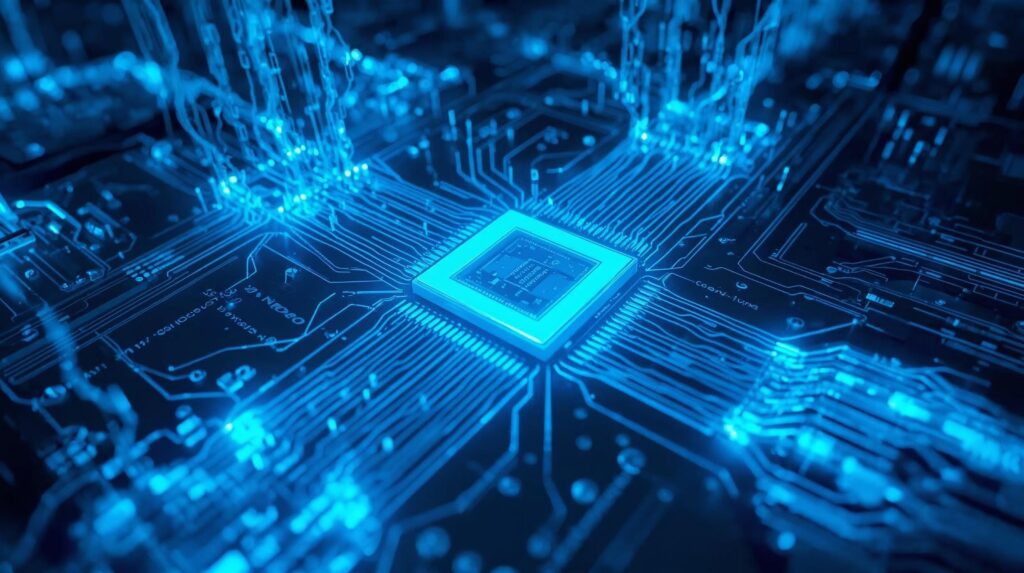
Inside a computer are billions of tiny electronic switches called transistors. Each transistor can exist in one of two states:
– On
– Off
Binary code perfectly matches this system.
The digit 1 represents “on,” and 0 represents “off.”
By combining billions of these tiny switches, computers can process enormous amounts of information.
🧠 From Simple Switches to Complex Information
A single binary digit is called a bit.
One bit alone cannot represent much information. But when bits are grouped together, their possibilities grow quickly.
For example:
– 8 bits form a unit called a byte
– A single byte can represent 256 different values
These values can correspond to letters, numbers, colors, or instructions.
That’s how computers convert binary patterns into the things we recognize — words, pictures, and sounds.
What appears simple on the surface becomes incredibly powerful when combined.
🔤 Turning Letters Into Binary
When you type a letter on your keyboard, your computer converts it into a binary number using standardized systems such as ASCII (American Standard Code for Information Interchange).
For instance:
– The letter A becomes 01000001
– The letter B becomes 01000010
Each letter has its own binary pattern.
When you type a sentence, your computer stores and processes it as a long sequence of zeros and ones.
To us, it’s language.
To the computer, it’s patterns of electrical signals.
🎵 Binary and Digital Media
Binary code doesn’t just represent text.
It also powers digital images, music, and video.
A digital photograph, for example, is stored as millions of tiny color values. Each pixel’s color is represented by binary numbers describing combinations of red, green, and blue light.
Similarly, music files convert sound waves into digital data by measuring amplitude thousands of times per second.
Even high-definition movies — which appear smooth and continuous — are ultimately sequences of binary numbers.
Everything digital becomes binary at the lowest level.
⚙️ Binary in Computer Instructions
Computers don’t just store information using binary. They also follow instructions written in binary.
Processors interpret specific binary patterns as commands, such as:
– Add two numbers
– Move data from memory
– Display a pixel on screen
– Play a sound
Early programmers sometimes worked directly with binary or its close cousin, machine code. Today, modern programming languages make development far easier, but underneath those languages, the computer still translates everything back into binary instructions.
The entire software ecosystem rests on those two digits.
🧮 A System Older Than Computers
Although binary code powers modern technology, the concept itself is surprisingly old.
In the 17th century, German mathematician Gottfried Wilhelm Leibniz studied binary mathematics and recognized its elegance. He realized that any number could be represented using only 0s and 1s.
Centuries later, engineers applied this idea to electronic circuits.
Binary’s simplicity made it perfect for machines that relied on electrical signals switching between two states.
Sometimes the most powerful ideas are also the simplest.
🌐 Binary and the Internet
When you browse the internet, enormous amounts of binary data travel across global networks.
Every email, webpage, and streaming video is broken into tiny packets of binary information that move through cables, routers, and satellites.
These packets travel thousands of kilometers in fractions of a second before being reassembled by your device.
The process feels instant, but beneath it lies an ocean of zeros and ones flowing through digital infrastructure.
Binary is the language of the internet itself.
🧠 The Beauty of Simplicity
One of the most fascinating aspects of binary code is how two symbols can create unlimited complexity.
By combining zeros and ones in different ways, computers can represent numbers, languages, images, music, and scientific data.
The same basic system powers:
– Smartphones
– Supercomputers
– Satellites
– Artificial intelligence systems
From simple switches emerges extraordinary capability.
💡 Two Digits That Changed the World
Binary code may look primitive compared to modern technologies, but it remains the invisible foundation beneath them all.
Every technological breakthrough — from video games to space exploration — ultimately depends on those tiny electrical states of on and off.
The digital world appears complex, but its language is surprisingly simple.
Just two numbers quietly running everything.
Continue Exploring on Trivialwiki
If you enjoyed learning about the invisible language powering modern technology, don’t miss our previous post:
👉 Ant Supercolonies: Millions of Insects Acting as One
Discover how vast networks of ants cooperate and behave like a single living organism.
📬 Stay Connected with Trivialwiki
👉 Facebook: https://facebook.com/Trivialwiki
👉 Instagram: https://instagram.com/trivialwiki
👉 YouTube: https://youtube.com/@trivialwiki
👉 Pinterest: https://pinterest.com/Trivialwiki
Learn. Explore. Discover.
Binary code powers every device we use today — what other invisible technologies do you think quietly shape our daily lives? Share your thoughts in the comments! 💻
1 thought on “Binary Code: The Two Numbers Running the Digital World”