
It sounds like a trick question.
Bananas feel like fruit. Strawberries feel like berries. Apples feel… well, like apples. Most of us assume we know what a berry is simply by looking at it.
Botany, however, has other plans.
According to plant science, bananas are berries — and strawberries are not. Neither are raspberries, blackberries, or mulberries. The classification has nothing to do with taste, size, or sweetness.
It comes down to structure. And once you understand it, your fruit bowl will never look the same again.
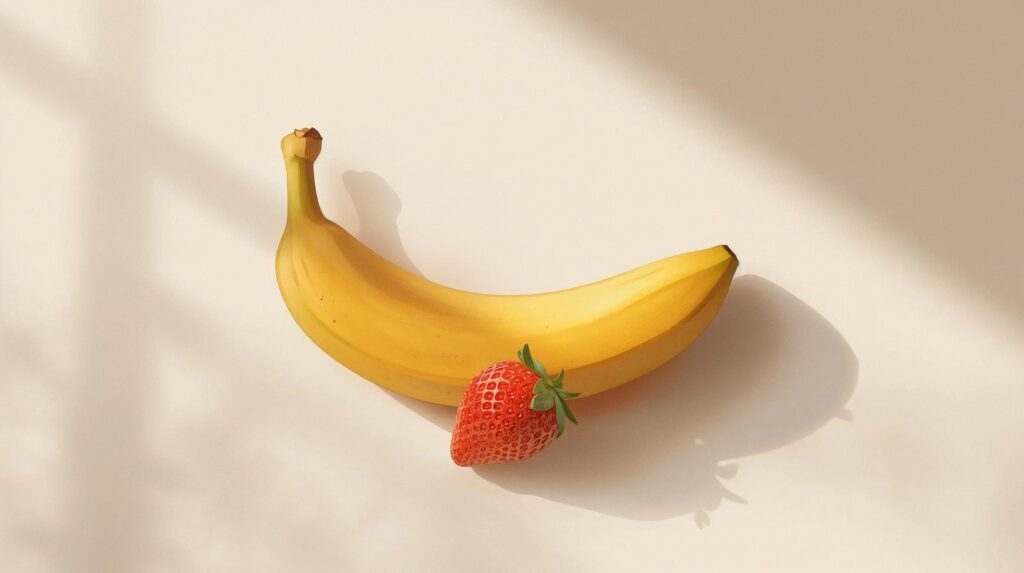
🍌 The Problem With Everyday Definitions
In everyday language, we group fruits by:
- Taste
- Texture
- Size
- How we use them in food
Botany doesn’t care about any of that.
Botanical definitions are based on how fruits develop from flowers. What matters is:
- Where the seeds come from
- How many flowers are involved
- How the fruit forms after pollination
This creates a gap between culinary logic and scientific reality — and bananas fall right into that gap.
🌸 What a Berry Actually Is (Botanically)
In botany, a berry is defined very precisely.
A true berry:
- Develops from a single flower
- Comes from a single ovary
- Has seeds embedded in the flesh
- Has a soft outer skin and fleshy interior
That’s it. No size requirement. No sweetness rule. No color preference.
Under this definition, bananas qualify perfectly.
🍌 Why Bananas Fit the Berry Definition
Bananas develop from a single flower with one ovary. As the flower matures, the ovary grows into the fruit, enclosing the seeds within the flesh.
Modern bananas don’t have hard seeds because they were selectively bred to be seedless. But if you look closely at the tiny black dots inside a banana, those are undeveloped seeds.
Structurally, bananas check every box.
They are, botanically speaking, textbook berries.
🍓 Why Strawberries Fail the Berry Test
Now for the twist.
Strawberries look like the most obvious berries imaginable — yet they fail the botanical definition entirely.
Here’s why:
- The red fleshy part is not the ovary
- The actual fruits are the tiny “seeds” on the outside
- Each of those tiny dots is technically a separate fruit
Strawberries are classified as aggregate fruits, not berries.
In botany, the strawberry’s seeds are the fruit — and the juicy red part is just a swollen receptacle.
Nature enjoys irony.
🍎 Apples, Pears, and Other Imposters
Apples and pears also fail the berry test.
They are classified as pomes, a category where the edible part comes from flower tissue surrounding the ovary rather than the ovary itself.
Cherries, peaches, and plums are drupes, with a single hard stone enclosing the seed.
Raspberries and blackberries? Also aggregate fruits — clusters of tiny drupelets.
The berry family is far smaller than most people assume.
🌿 Who Else Is a Berry?
Once you accept the botanical rules, the list of berries becomes surprising.
True berries include:
- Bananas
- Grapes
- Tomatoes
- Eggplants
- Avocados
Yes — tomatoes are berries. Avocados are berries. Eggplants are berries.
Your salad may contain more berries than your dessert.
🧠 Why Botany Uses Such Strict Definitions
Botanical classification isn’t meant to be intuitive.
Its goal is to:
- Track plant evolution
- Understand reproduction
- Group plants by shared structure
These definitions help scientists study how plants evolved and how different species are related, even if the results feel counterintuitive.
What seems “wrong” to us often makes perfect sense in evolutionary terms.
🍌 A Note on Banana Plants (Another Surprise)
While we’re unsettling assumptions, here’s another banana fact.
Banana plants aren’t trees.
They’re giant herbs.
The “trunk” is actually layers of tightly packed leaves. There’s no woody tissue involved. This makes the banana plant the largest herbaceous flowering plant in the world.
So the banana breaks expectations twice:
a berry that grows on a plant that isn’t a tree.
🌍 Why This Knowledge Rarely Matters — But Still Delights
From a practical standpoint, none of this changes how we eat fruit.
Recipes won’t change. Grocery labels won’t update. Strawberry jam will still be called strawberry jam.
But facts like this matter because they remind us that nature doesn’t organize itself around human intuition.
Scientific categories reflect processes, not appearances.
And sometimes, learning that difference is the fun part.
💡 When Language and Science Collide
Words evolve for convenience. Science evolves for accuracy.
The word “berry” in everyday language means something very different from what it means in botany. Neither is wrong — they simply serve different purposes.
Understanding that distinction helps explain why science is often surprising rather than comforting.
Reality doesn’t always align with expectation.
🧠 A Small Fact With a Big Lesson
The banana-as-a-berry fact isn’t just trivia.
It’s a reminder that:
- Familiar things can still surprise us
- Categories are human-made tools
- Nature follows its own logic
Sometimes, the most interesting discoveries aren’t about distant galaxies or rare particles — they’re about what’s already sitting on your kitchen counter.
Continue Exploring on Trivialwiki
If you enjoyed uncovering a hidden truth about everyday food, don’t miss our previous post:
👉 Octopus Intelligence: The Animal With Three Hearts and Nine Brains
A fascinating look at one of nature’s most unconventional minds — and what it teaches us about intelligence itself.
📬 Stay Connected with Trivialwiki
–––––––––––––––––––––––––––––
👉 Facebook: https://facebook.com/Trivialwiki
👉 Instagram: https://instagram.com/trivialwiki
👉 YouTube: https://youtube.com/@trivialwiki
👉 Pinterest: https://pinterest.com/Trivialwiki
Learn. Explore. Discover.
–––––––––––––––––––––––––––––
Bananas being berries challenges how we casually label the world — what other everyday “facts” do you think might be quietly wrong?
Share your thoughts in the comments and keep the curiosity fresh 🍌🍓
1 thought on “Bananas Are Berries: A Botanical Surprise”