
Most cities are built on solid ground.
Their foundations rest on rock, soil, or bedrock strong enough to support buildings, roads, and generations of growth. When people imagine an ideal location for a city, they rarely picture muddy islands surrounded by shallow water.
Yet one of the world’s most famous cities was built in exactly that environment.
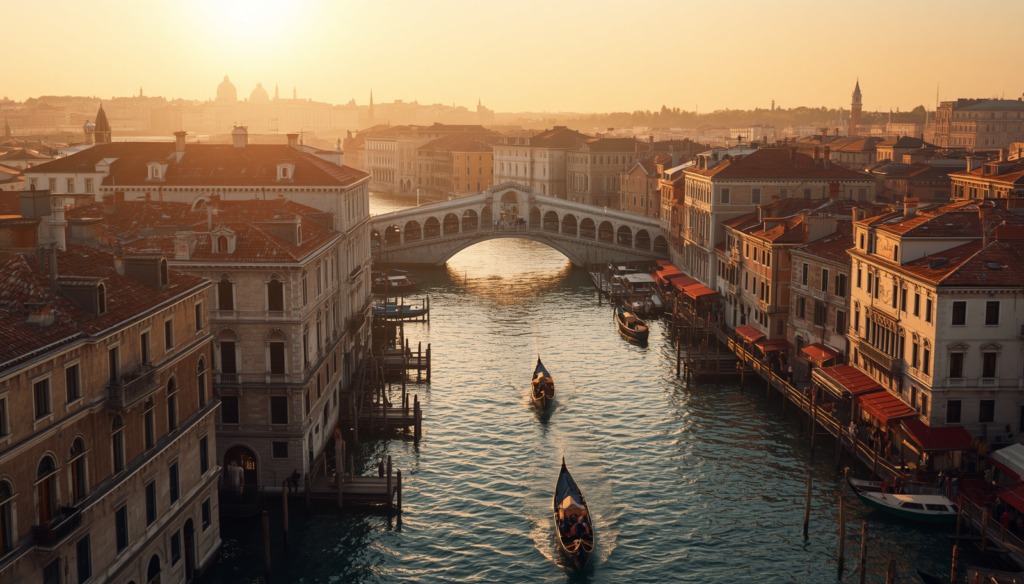
For centuries, Venice has appeared almost impossible. Grand palaces rise from the water. Elegant bridges connect narrow streets. Boats glide through canals where cars would normally travel. Visitors often leave wondering the same thing:
How does this city even exist?
The answer is a remarkable story of ingenuity, determination, and engineering. Venice is not simply a city built near water—it is a city that learned how to float.
🌊 A Refuge Born from Crisis
The origins of Venice can be traced back more than 1,500 years.
During the decline of the Western Roman Empire, northern Italy faced repeated invasions from various groups moving across Europe. As conflict spread across the mainland, many people sought safety in the marshy islands of a large lagoon along the Adriatic Sea.
At first, these islands seemed like an unlikely place to build a permanent settlement.
The land was muddy, unstable, and frequently affected by tides. Farming was difficult, and constructing large buildings appeared almost impossible.
Yet the surrounding waters offered protection.
Invading armies found it difficult to navigate the shallow lagoon, making the islands a natural refuge for people seeking security.
What began as scattered communities gradually evolved into something much larger.
🪵 Building on Mud
The greatest challenge facing early Venetians was obvious.
How do you build a city on soft mud?
The solution was surprisingly clever.
Workers drove millions of wooden piles deep into the muddy ground beneath the lagoon. These long wooden poles were typically made from durable species such as alder, oak, and larch.
At first glance, wood might seem like a poor choice for supporting massive buildings. Normally, wood exposed to water eventually rots.
However, conditions beneath the lagoon were unique.
Once submerged in oxygen-poor mud, the wood was protected from many of the organisms that cause decay. Over time, minerals in the water gradually hardened the timber, creating remarkably stable foundations.
Above these piles, builders placed wooden platforms and stone foundations upon which buildings could rise.
Much of Venice still stands on these centuries-old supports today.
🏛️ A City of Merchants and Mariners
Venice’s location provided more than protection.
It also offered access to trade.
Positioned between Europe and the eastern Mediterranean, Venice became a crucial hub for merchants transporting goods across continents.
Ships arrived carrying:
- spices
- silk
- precious metals
- textiles
- exotic products from distant lands
As trade expanded, Venice grew wealthy.
The city developed powerful naval forces, impressive architecture, and extensive commercial networks stretching across Europe, North Africa, and parts of Asia.
For centuries, the Republic of Venice became one of the most influential maritime powers in the world.
Its prosperity helped fund many of the magnificent buildings that still attract visitors today.
🚤 Streets Made of Water
One of Venice’s most distinctive features is its transportation system.
Unlike most cities, Venice developed around canals rather than roads.
The famous Grand Canal serves as the city’s main waterway, winding through Venice in a broad S-shaped path.
Instead of cars and buses, traditional boats became essential for moving people and goods.
Even today, much of Venice remains inaccessible to conventional vehicles.
Visitors often travel by:
- water buses
- water taxis
- gondolas
- small private boats
This unique layout gives Venice an atmosphere unlike anywhere else on Earth.
The city feels both ancient and surprisingly alive.
🎭 The Golden Age of Venice
Between the Middle Ages and the Renaissance, Venice reached extraordinary heights of wealth and influence.
Artists, architects, merchants, and explorers contributed to a vibrant culture that left a lasting mark on history.
Venice became famous for:
- art
- music
- literature
- glassmaking
- shipbuilding
Its shipyards were among the most advanced industrial operations of their time.
The Venetian Arsenal could produce ships on a scale that astonished visitors from across Europe.
Some historians view it as an early example of large-scale industrial manufacturing.
At a time when many cities remained relatively small, Venice had become an international center of commerce and culture.
🌉 The City of Bridges
Because Venice consists of more than 100 small islands connected by waterways, bridges became essential.
Today, hundreds of bridges connect different parts of the city.
Among the most famous is the Rialto Bridge, which has crossed the Grand Canal for centuries.
Walking through Venice often feels like navigating a maze.
Narrow alleys suddenly open into lively squares. Small canals appear around unexpected corners. Historic buildings emerge from spaces that seem too small to contain them.
The city’s layout evolved organically over many centuries, creating a landscape that feels both complex and enchanting.
🌊 A City Facing New Challenges
Despite its long history of adaptation, Venice faces serious challenges today.
One of the most significant is flooding.
A phenomenon known as Acqua Alta, or “high water,” periodically causes parts of the city to flood when tides, winds, and weather conditions align.
Climate change and rising sea levels have increased concerns about Venice’s future.
In response, engineers have developed large-scale flood protection projects designed to shield the lagoon from extreme tides.
These efforts represent the latest chapter in Venice’s long struggle to coexist with water.
For centuries, the city has adapted to changing conditions.
Its survival continues to depend on innovation.
🌍 A Place Unlike Any Other
Many cities are famous for landmarks.
Venice is famous because the entire city feels like a landmark.
Its canals, architecture, bridges, and history combine to create an environment unlike any other on Earth.
Millions of visitors travel there each year not simply to see a building or monument, but to experience a city that seems to challenge the rules of geography.
Venice reminds us that human creativity can overcome extraordinary obstacles.
💡 The Floating City That Refused to Sink
Few places better demonstrate humanity’s ability to adapt than Venice.
Faced with unstable islands and difficult conditions, its inhabitants created a thriving city that survived for more than a millennium.
They transformed mudflats into a center of trade, culture, and innovation.
What appears impossible at first glance turns out to be a masterpiece of engineering and determination.
Venice did not merely survive on the water.
It learned how to float.
📖 Keep Exploring
If you enjoyed learning how human ingenuity transformed an unlikely location into one of the world’s most remarkable cities, don’t miss our previous post:
👉 The Machine That Changed Human Knowledge Forever
Discover how Johannes Gutenberg’s printing press revolutionized communication, accelerated the spread of ideas, and helped shape the modern world.
📬 Stay Connected with Trivialwiki
👉 Facebook: https://facebook.com/Trivialwiki
👉 Instagram: https://instagram.com/trivialwiki
👉 YouTube: https://youtube.com/@trivialwiki
👉 Pinterest: https://pinterest.com/Trivialwiki
Learn. Explore. Discover.
Venice has stood on wooden foundations for centuries despite being surrounded by water. Which city do you think has the most fascinating origin story? Share your thoughts in the comments! 🚣🌍
Great content! Keep up the good work!