
Imagine stepping into a lake and discovering that sinking is almost impossible.
Instead of struggling to stay afloat, your body rises effortlessly to the surface. You can lean back, stretch out, and float with remarkable ease. To first-time visitors, the experience often feels almost magical.
This unusual phenomenon occurs in one of the world’s most famous bodies of water: the Dead Sea.
Located between Jordan and Israel, the Dead Sea attracts visitors from around the globe who come to experience its extraordinary buoyancy. Yet floating is only part of the story. Behind this famous lake lies a fascinating combination of geology, chemistry, history, and environmental change.
The Dead Sea is not only one of the most unusual places on Earth—it is also one of the most scientifically interesting.
🌍 A Sea That Isn’t Actually a Sea
Despite its name, the Dead Sea is technically a lake.
Unlike oceans and seas, which connect to larger bodies of water, the Dead Sea is landlocked. Water flows into it primarily through the Jordan River, but there is no outlet where water flows back out.
This creates a unique situation.
As water enters the lake, it can only leave through evaporation. Over thousands of years, this process has concentrated enormous amounts of dissolved minerals and salts.
The result is a body of water unlike almost any other on Earth.
🧂 Why Is the Dead Sea So Salty?
The Dead Sea contains an astonishing concentration of salt.
While the world’s oceans typically contain about 3.5% salt, the Dead Sea contains roughly ten times that amount.
As rivers carry minerals into the lake, the water evaporates under the region’s hot climate. The minerals remain behind and gradually accumulate.
Over countless centuries, this process transformed the lake into an incredibly dense mixture of water and dissolved salts.
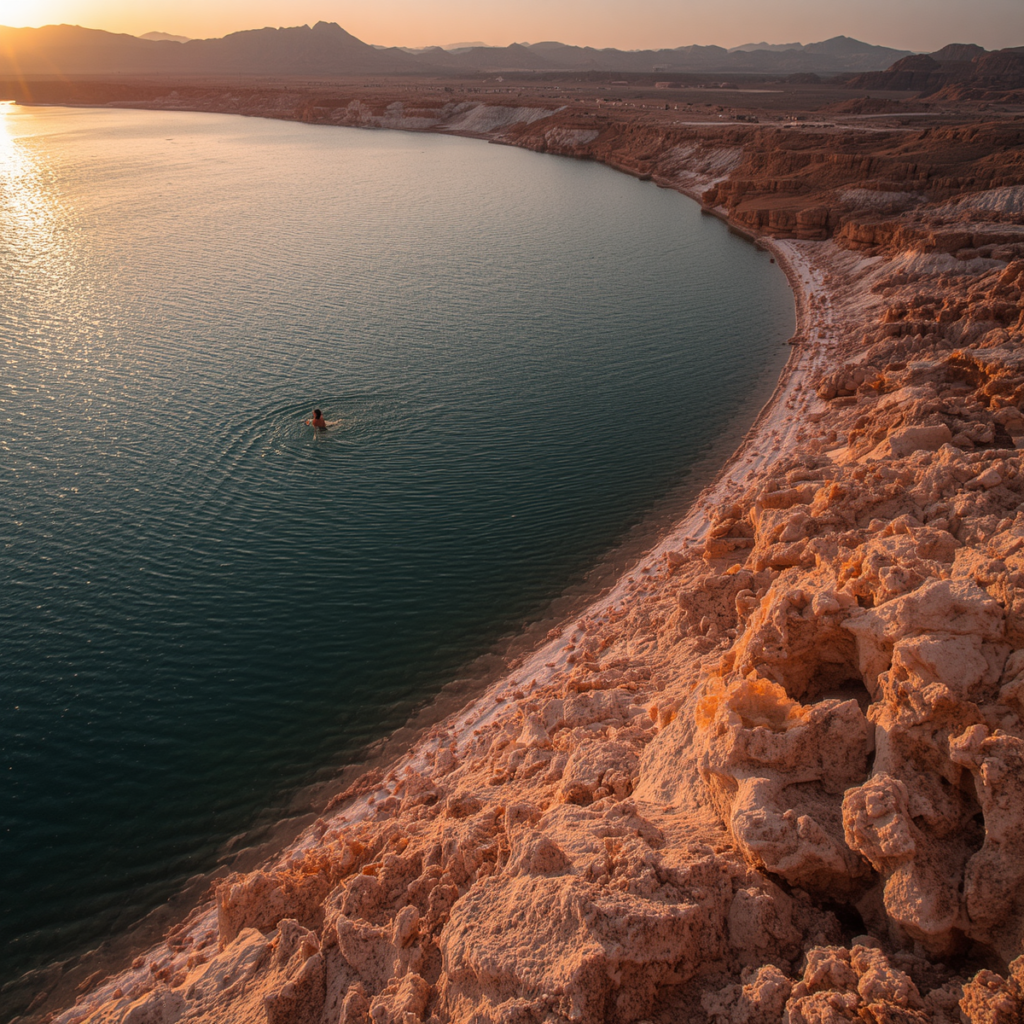
The shoreline itself often displays beautiful salt formations, crystals, and mineral deposits that create an almost otherworldly landscape.
🏊 The Science Behind Floating
The famous floating effect comes down to a simple scientific principle: density.
When an object is placed in water, it experiences an upward force known as buoyancy.
In ordinary lakes and oceans, people float because the body’s density is roughly similar to that of water. However, in the Dead Sea, the water is much denser because of its extremely high salt content.
This denser water pushes upward with greater force.
As a result, the human body floats much more easily than it would in most other bodies of water.
Visitors often find themselves floating effortlessly while reading a newspaper or simply relaxing on the surface.
The experience has become one of the most iconic travel photographs in the world.
🦠 Why It’s Called the Dead Sea
The lake’s unusual chemistry creates another remarkable characteristic.
Very few organisms can survive in its highly saline environment.
Fish that accidentally enter from freshwater sources typically cannot survive for long, and most aquatic plants are absent as well.
This lack of visible aquatic life led people to call it the “Dead Sea.”
However, the name is not entirely accurate.
Scientists have discovered certain microorganisms, including specialized bacteria and microscopic life forms, that can survive in the extreme conditions.
While the lake is far less biologically active than most bodies of water, it is not completely lifeless.
📜 A Place Steeped in History
The Dead Sea has been known to humans for thousands of years.
Ancient civilizations valued the region for its minerals, trade routes, and strategic location.
Historical records connect the area to:
- ancient kingdoms
- biblical narratives
- Roman trade networks
- early medicinal practices
Throughout history, people harvested minerals and natural substances from the region, believing they possessed therapeutic properties.
The area has attracted travelers, merchants, rulers, and pilgrims for centuries.
Few natural landmarks combine such rich historical significance with such unusual scientific characteristics.
💆 Nature’s Mineral Spa
The Dead Sea is also famous for its mineral-rich mud.
Many visitors cover themselves in the dark mud found along the shoreline before rinsing it off in the lake.
The mud contains a variety of minerals that have made the area popular for wellness tourism.
Whether or not every health claim is scientifically supported, the region has developed a global reputation as a natural spa destination.
Hotels, resorts, and wellness centers have flourished around the shoreline, attracting visitors seeking both relaxation and curiosity.
📉 A Lake That’s Shrinking
Despite its fame, the Dead Sea faces a serious environmental challenge.
Over the past several decades, the lake’s water level has been declining significantly.
Several factors contribute to this problem.
Water from the Jordan River is increasingly diverted for agriculture, industry, and human consumption before it reaches the lake. At the same time, the region’s hot climate continues to drive intense evaporation.
As a result, the shoreline has been retreating year after year.
In some areas, the water level has dropped dramatically compared to historical records.
Scientists and governments continue exploring ways to address the issue and protect this unique natural wonder.
🌎 One of Earth’s Lowest Places
The Dead Sea holds another impressive distinction.
Its shoreline sits more than 400 meters below sea level, making it the lowest exposed land point on Earth.
Standing on its shores means standing at one of the lowest elevations accessible without diving beneath the ocean.
This unusual geography contributes to the region’s distinctive climate and environment.
Combined with its high salinity, it makes the Dead Sea one of the most extraordinary landscapes on the planet.
💡 A Natural Wonder Unlike Any Other
The Dead Sea is a place where science feels almost magical.
People float effortlessly. Salt crystals cover the landscape. Ancient history meets modern tourism. And one of the world’s most famous lakes continues to challenge our expectations about how nature works.
Its existence is a reminder that some of Earth’s most fascinating wonders emerge from simple natural processes operating over immense periods of time.
A lake that refuses to let you sink may sound impossible.
Yet on the shores of the Dead Sea, it is simply everyday reality.
Continue Exploring on Trivialwiki
If you enjoyed learning about unusual places on our planet, don’t miss our previous post:
👉 The Invisible Parking Spots of Space
Discover how hidden regions of gravitational balance help spacecraft operate efficiently throughout the Solar System.
📬 Stay Connected with Trivialwiki
👉 Facebook: https://facebook.com/Trivialwiki
👉 Instagram: https://instagram.com/trivialwiki
👉 YouTube: https://youtube.com/@trivialwiki
👉 Pinterest: https://pinterest.com/Trivialwiki
Learn. Explore. Discover.
The Dead Sea’s extraordinary salt concentration allows people to float with ease—but would you add it to your travel bucket list? Share your thoughts in the comments! 🌊🧂
1 thought on “The Dead Sea: The Lake That Refuses to Let You Sink”