
Right now, as you read this, your fingers probably know exactly where to go.
Q, W, E, R, T, Y — a familiar pattern you’ve used thousands of times without thinking about it. Whether you’re typing on a laptop, phone, tablet, or desktop keyboard, the layout is almost certainly the same.
What’s strange is not that it feels natural.
What’s strange is that this layout was designed more than 150 years ago, for machines that no longer exist — yet it still dominates the digital world.
So how did an old typewriter layout become one of the most enduring designs in human history?
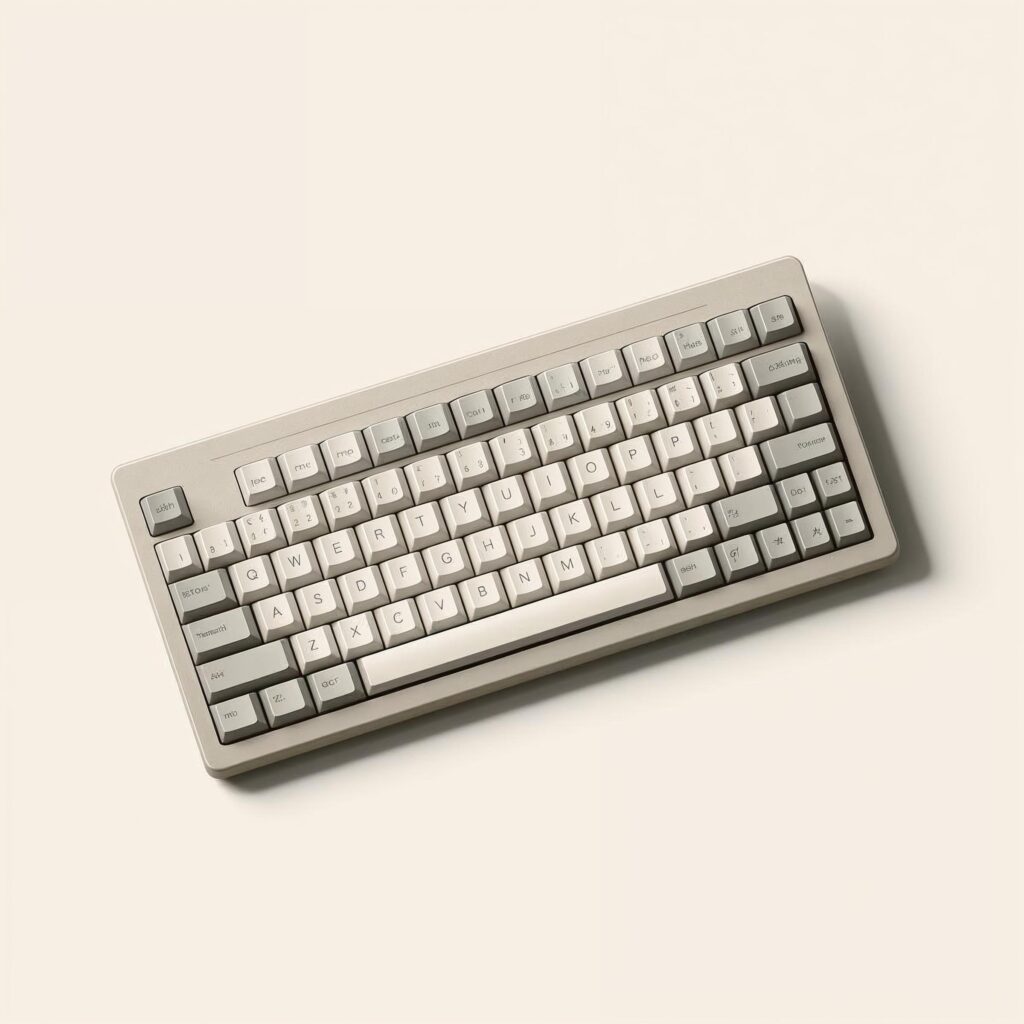
🕰️ A Keyboard Born in the Age of Typewriters
The QWERTY keyboard dates back to the 19th century, when typing meant striking metal arms against inked ribbons and paper.
Early typewriters had a problem. A big one.
If someone typed too fast, the metal typebars would collide and jam. The faster and more skilled the typist, the worse the problem became. Speed was the enemy of reliability.
The keyboard layout wasn’t designed to help people type faster.
It was designed to slow them down just enough.
Letters that commonly appeared together in English were deliberately spaced apart, reducing the chances of mechanical collisions. QWERTY wasn’t about comfort or efficiency — it was about keeping the machine working.
Ironically, that limitation would shape the future of typing forever.
⌨️ QWERTY Solved a Mechanical Problem — Not a Human One
This is the part many people find surprising.
QWERTY was never intended to be the best layout for human hands. It was a compromise, built around the weaknesses of early machines.
Once typewriters improved and jamming became less of an issue, the original reason for QWERTY quietly disappeared. But by then, something else had happened.
People had learned it.
🧠 Muscle Memory Is a Powerful Force
Typing isn’t a conscious activity. You don’t think about individual keys — your fingers move on their own.
That’s muscle memory at work.
Once millions of people had trained their hands on QWERTY, switching layouts became incredibly difficult. Even if another keyboard promised better speed or comfort, relearning decades of habits came at a real cost.
The layout wasn’t just on the keys anymore.
It was in people’s hands.
📈 When “Good Enough” Beats “Better”
Over the years, many alternatives to QWERTY have been proposed. Some are objectively more efficient. Some reduce finger movement. Some are designed to minimize strain.
Yet none of them replaced QWERTY on a large scale.
Why?
Because systems don’t change just because something better exists. They change only when the benefit outweighs the pain of switching.
For most people, QWERTY works well enough. It’s familiar. It’s supported everywhere. And everyone else uses it too.
That network effect is incredibly hard to break.
🌍 Standardization Changed Everything
Once QWERTY became the default, everything began aligning around it.
- Typing classes taught it
- Office jobs required it
- Exams tested it
- Manufacturers built hardware around it
By the time computers arrived, QWERTY was no longer a design choice. It was a given.
Software, operating systems, and digital tools all inherited the layout without question. What started as a mechanical workaround quietly became a global standard.
📱 Why QWERTY Survived the Digital Revolution
You might expect QWERTY to fade away once physical typewriters disappeared. After all, smartphones and touchscreens don’t jam.
But something interesting happened.
Instead of abandoning QWERTY, we adapted it.
Virtual keyboards, predictive text, autocorrect — all of them were built on top of QWERTY rather than replacing it. Designers chose familiarity over reinvention.
Learning curves matter. Even in the digital age, comfort and habit often beat optimization.
✋ Comfort Isn’t Just Physical — It’s Mental
QWERTY feels comfortable not because it’s perfect, but because it’s known.
You know where letters are without looking. You trust your fingers. You can type while thinking about something else.
That cognitive ease is valuable. Changing layouts would introduce friction into one of the most common actions people perform every day.
And humans are remarkably resistant to friction.
🧩 A Design That Became Invisible
One of the strongest signs of good design is invisibility.
QWERTY doesn’t draw attention to itself. It doesn’t demand explanation. It simply works — quietly, consistently, and everywhere.
Over time, it stopped being “a design” and became part of the background of daily life.
We don’t ask why the letters are arranged this way. We just type.
💡 The Bigger Lesson QWERTY Teaches Us
The story of QWERTY isn’t really about keyboards.
It’s about how human systems evolve.
Better ideas don’t always win. Sometimes the first widely adopted solution becomes too entrenched to replace. Habit, training, infrastructure, and shared experience can outweigh technical superiority.
Progress isn’t always about improvement. Sometimes it’s about momentum.
🔄 Could QWERTY Ever Be Replaced?
It’s possible — but unlikely.
A replacement would need to be:
- Dramatically better
- Easy to learn
- Backed by massive institutional support
- Compatible with existing systems
Until then, QWERTY remains the path of least resistance.
Not because it’s perfect — but because it’s everywhere.
Continue Exploring on Trivialwiki
If you enjoyed uncovering the story behind one of the world’s most familiar designs, don’t miss our previous post:
👉 Coins: The Circular Design That Survived Centuries
A fascinating look at how a simple shape quietly solved countless problems — and never needed improvement.
📬 Stay Connected with Trivialwiki
–––––––––––––––––––––––––––––
👉 Facebook: https://facebook.com/Trivialwiki
👉 Instagram: https://instagram.com/trivialwiki
👉 YouTube: https://youtube.com/@trivialwiki
👉 Pinterest: https://pinterest.com/Trivialwiki
Learn. Explore. Discover.
–––––––––––––––––––––––––––––
The QWERTY keyboard survived not because it was ideal, but because it became familiar — what other everyday designs do you think we keep using simply because changing them feels harder than living with them?
Share your thoughts in the comments and keep the curiosity alive.
1 thought on “QWERTY Keyboards: A 150-Year-Old Design We Still Can’t Let Go Of”