
Coins are among the oldest objects humans still use every day.
They pass through countless hands, pockets, and purses. They survive drops, scratches, water, dirt, and time itself. And despite thousands of years of technological progress, their basic shape has barely changed.
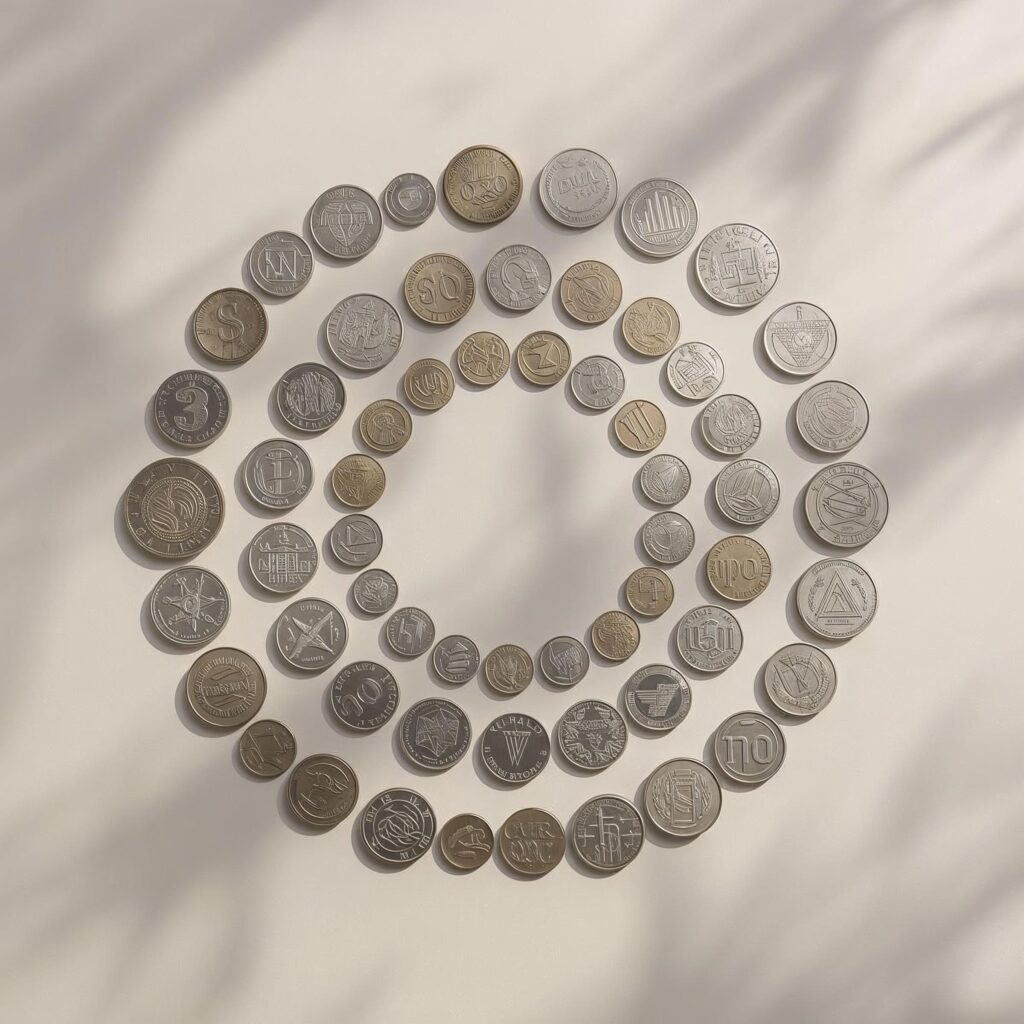
Round. Flat. Circular.
This isn’t tradition for tradition’s sake. The circular coin is one of history’s most successful design decisions—shaped by physics, practicality, economics, and human behavior.
So why did circles win? And why haven’t we improved on them yet?
🪙 Coins Are Older Than You Think
The first metal coins appeared over 2,500 years ago, long before paper money, banks, or digital transactions. Early civilizations needed a durable, standardized way to trade value—something more reliable than barter.
Metal fit the need. But metal came with a challenge: what shape should it be?
Squares, rectangles, and irregular chunks were all tried at various points. Over time, one shape proved superior in almost every practical way.
The circle quietly took over.
🔄 A Shape That Rolls With the World
One of the simplest advantages of a circular coin is movement.
Round objects roll smoothly. They don’t snag, catch, or resist motion the way corners do. This mattered in ancient times when coins were stored in sacks, poured into piles, or counted quickly by hand.
Merchants could spill coins, scoop them up, and stack them efficiently. The shape reduced friction—both literal and economic.
A coin that moves easily moves commerce forward.
⚖️ Circles Are Fair by Design
A circle has no corners. That might sound trivial, but it solved a serious historical problem: cheating.
When coins were made of precious metals like gold and silver, dishonest traders would shave small amounts from the edges to collect valuable dust over time. This was much harder to do evenly on a round shape without being noticed.
Eventually, ridged or patterned edges were added—but the circular form made edge tampering easier to detect in the first place.
A fair shape helped protect trust.
🧠 The Brain Loves Symmetry
Humans are instinctively drawn to symmetry. We associate it with balance, reliability, and completeness.
A circular coin feels “right” in the hand. There’s no orientation to worry about. No wrong way to hold it. No need to rotate it to understand it.
This psychological simplicity made coins easier to accept and harder to question. When money feels intuitive, people trust it faster.
Good design doesn’t demand attention—it disappears.
✋ Coins Were Designed for Hands, Not Eyes
Long before machines counted money, fingers did.
Circular coins are easy to:
- Stack
- Flip
- Slide
- Count by touch
Even today, many people can identify coins by feel alone—size, thickness, weight, and edge texture. The round shape ensures smooth handling without sharp edges or awkward angles.
Money had to work in the dark, in crowds, and under pressure. Circles passed every test.
🏗️ Manufacturing Made Circles Inevitable
From a production standpoint, circular coins are efficient.
Early minting techniques involved hammering metal between engraved dies. A round shape distributed force evenly, reducing cracks and defects.
Even with modern minting, circles:
- Wear evenly
- Resist deformation
- Fit smoothly into machines
Vending machines, parking meters, and sorting systems all rely on round coins behaving predictably.
Changing the shape would break more systems than it would improve.
🪜 Why Not Squares or Triangles?
Some cultures experimented with non-circular coins. They worked—but never scaled.
Corners wore down faster. Irregular shapes jammed counting tools. Stacking became awkward. Storage wasted space.
Over time, economics favored what worked best.
The circle wasn’t chosen because it was beautiful. It survived because it was useful.
🧩 A Shape That Adapts Without Changing
What’s remarkable is not that coins stayed circular—but that the shape adapted without losing its identity.
Over centuries, coins evolved in:
- Size
- Thickness
- Material
- Edge design
- Visual detail
Yet the core geometry stayed the same.
This allowed societies to innovate without breaking familiarity. People accepted new coins because they still felt like money.
Continuity builds confidence.
🌍 A Universal Language of Value
Travel anywhere in the world and you’ll find coins that look different—but feel similar.
That’s no accident.
The circular coin became a global design standard, understood across cultures and centuries. You may not recognize the symbols or language, but the shape signals value instantly.
Few human-made objects enjoy that level of universal recognition.
💡 When Design Outlives Technology
In an age of contactless payments, digital wallets, and virtual currencies, coins might seem outdated.
Yet they persist.
Why? Because their design is already optimized. Coins don’t crash. They don’t need batteries. They don’t forget passwords.
The circular coin survived centuries not by resisting change—but by being good enough from the start.
🧠 Small Object, Big Lesson
Coins remind us that progress isn’t always about reinvention. Sometimes it’s about recognizing when a solution is already near-perfect.
The circle didn’t win because it was clever. It won because it quietly solved dozens of problems at once.
That’s the hallmark of timeless design.
Continue Exploring on Trivialwiki
If you enjoyed uncovering the hidden logic behind one of humanity’s oldest everyday objects, don’t miss our previous post:
👉 Tickling: The Human Body’s Strangest Defense Mechanism
A fascinating look at why laughter can be involuntary—and what it reveals about the human nervous system.
📬 Stay Connected with Trivialwiki
–––––––––––––––––––––––––––––
👉 Facebook: https://facebook.com/Trivialwiki
👉 Instagram: https://instagram.com/trivialwiki
👉 YouTube: https://youtube.com/@trivialwiki
👉 Pinterest: https://pinterest.com/Trivialwiki
Learn. Explore. Discover.
–––––––––––––––––––––––––––––
The circular coin has survived thousands of years — what other everyday designs do you think are so perfect that they’ll never need changing?
Share your thoughts in the comments and keep the curiosity going.
great